
Ciao Italia: Rome, Florence, Pisa & Venice by Train
September 2024 9 days By Ange Pabón Last updated November 2026
Ancient ruins, endless walks, Renaissance art and a city built on water. Four stops, ten nights and an Italian adventure to remember.
TL;DR We travelled through Italy by train, spending four nights in Rome, three in Florence and three in Venice, with a day trip to Pisa. Book major attractions in advance, bring comfortable shoes, refill your water bottle at Rome's public fountains and keep an umbrella handy for Venice. Most importantly, leave time to wander.
After exploring Prague and Vienna, Italy was the final chapter of our trip in September and October 2024. We had ten nights to explore three cities, plus a day trip to Pisa. There were famous landmarks we couldn't wait to see, places we discovered while walking around and a few things that didn't go quite as planned.
From the heat of Rome to the narrow streets of Florence and the grey skies of Venice, every stop felt different. Here's how we experienced Italy, what I'd recommend and what I'd do differently next time.
Rome: Ancient ruins, beautiful ceilings and endless walking
Rome was our first stop, and we spent four nights here. We explored much of the city on foot, walking between ancient ruins, churches, fountains and squares.
What surprised me was how often we'd be heading somewhere specific and end up stopping to admire something completely unexpected along the way. There's just so much history everywhere you look.
Getting lost between churches and fountains
One of our walks took us along the Tiber River, past Castel Sant'Angelo and Ponte Sant'Angelo, before reaching Piazza Navona. There we found the Fountain of Neptune, the Fountain of the Moor and the church of Sant'Agnese in Agone. We also visited the Basilica di Sant'Agostino in Campo Marzio.
Something I particularly loved about Rome was stepping into its churches. From the outside, you might not imagine just how beautiful they are inside. The painted ceilings, the domes, the details everywhere. Sant'Agnese was one of those places that made me stop and look up.
If there's one thing I'd recommend while wandering through Rome, it's to step inside some of the churches you come across. Even if they weren't originally part of your plans.
The Pantheon, and the crowds that come with it
The Pantheon was another place we wanted to see. It was packed when we arrived, with people everywhere around the square, but we still went inside.
The area around it is one of those parts of Rome where walking can get a little chaotic, especially with so many people and vehicles sharing the narrow streets. Still, it's absolutely worth visiting.
The Pantheon requires an entrance ticket. We paid €5 per person in 2024. Check the official website for updated prices and visiting conditions.
The Colosseum and Roman Forum: Give yourself time
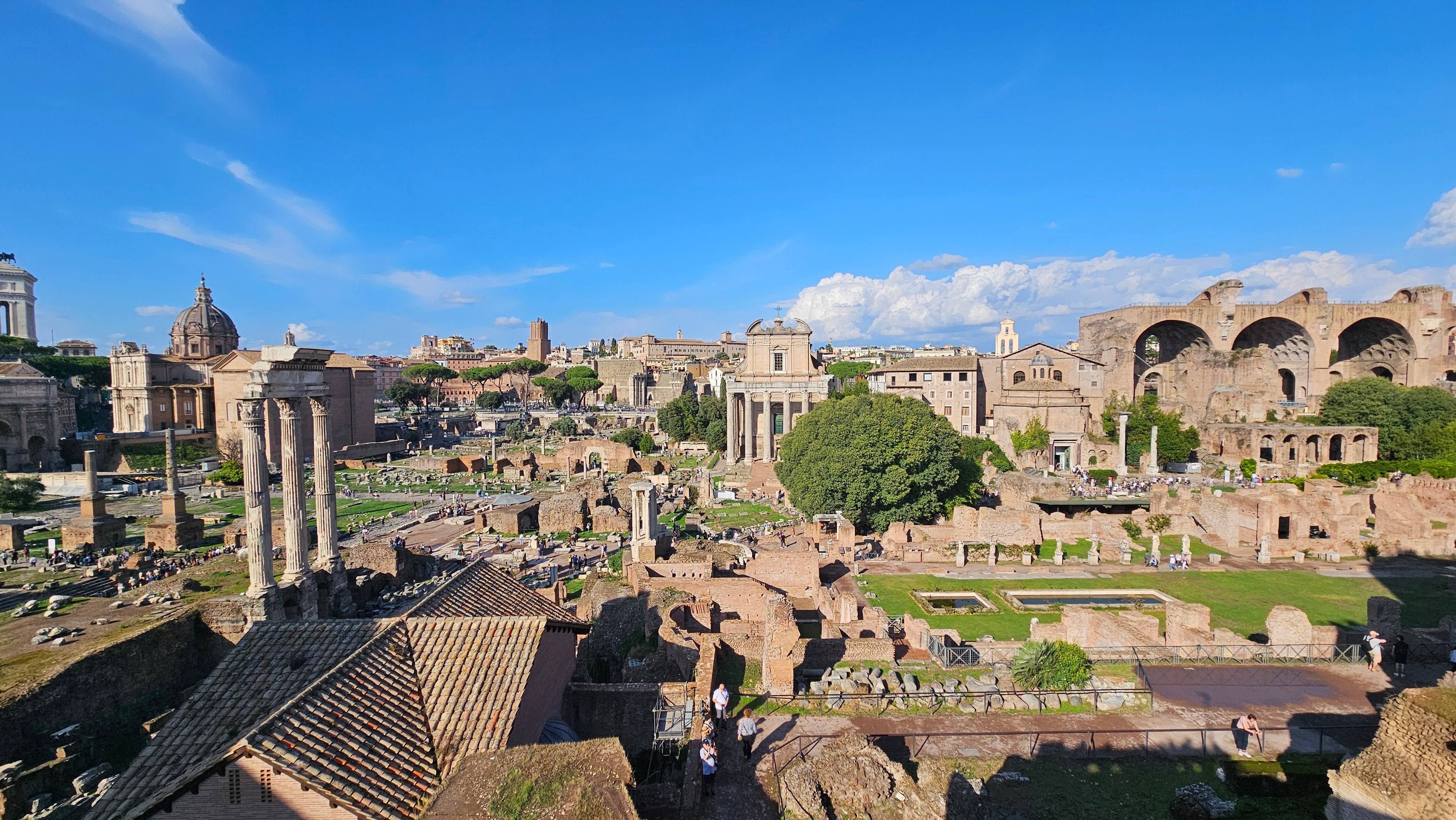
Of course, we couldn't visit Rome without seeing the Colosseum. We booked our tickets in advance and chose a Full Experience option that included the Colosseum, Roman Forum and Palatine Hill. And I'm glad we gave ourselves enough time to explore.
Walking inside the Colosseum is completely different from seeing it in photographs or from the outside. The scale of the place, the structure and the history behind it make it an experience worth taking your time with.
We continued through the Roman Forum, passing ancient ruins, the Arch of Titus and the Domus Tiberiana. There's a lot to see, and we spent most of the day exploring the archaeological area.
It was also a properly hot day. Having a cap and a bottle of water made a big difference, especially after hours of walking under the sun.
The ticket we used
- Full Experience
- €25 per person in 2024
- Presale fee included
Our visit covered the Colosseum, Roman Forum and Palatine Hill. We did not visit the underground areas or attic.
There are several Full Experience ticket options with different access conditions. Check which areas are included on the official Colosseum ticket site before booking.
My tip: Don't try to squeeze the Colosseum, Forum and several other major attractions into one morning. Give yourself enough time to enjoy the archaeological area without rushing.
For photography: I loved photographing the Colosseum in bright daylight, especially with the blue sky behind it. Golden hour is another beautiful time to capture it from the outside.
A little Rome tip: you don't need to keep buying water. One of the most useful things to know about Rome is that the city has free public drinking fountains called nasoni. You can refill your bottle while walking around instead of buying bottled water throughout the day. This was especially helpful with the heat.
Bring a reusable bottle. It's a small thing, but you'll appreciate it after hours of exploring.
The Vatican, from the basilica to the dome
Visiting the Vatican was another highlight of our time in Rome. We booked ahead, which I'd definitely recommend if you're planning to visit the Vatican Museums and Sistine Chapel.
What stayed with me most was the incredible artwork. The paintings, the ceilings and how beautifully everything has been preserved.
We also visited St. Peter's Basilica and climbed its dome on foot. There was a queue to go up, and the climb took some effort, but once we reached the top, the view made it worthwhile. Looking out over St. Peter's Square and the city beyond was one of my favourite views in Rome.
My tip: Plan ahead if you want to visit both the Vatican Museums and St. Peter's Basilica. They're separate visits, and you'll need extra time if you also want to climb the dome. Arriving early can help, but don't assume the queues will be short.
Trevi Fountain, the Spanish Steps and a very busy Rome
Rome was crowded almost everywhere we went. At the Trevi Fountain, there were so many people trying to take photographs that getting a clear view wasn't exactly easy.
The Spanish Steps were another popular stop, with crowds gathered around Piazza di Spagna and the view toward Trinità dei Monti. We also passed through Piazza Venezia, where the enormous Altare della Patria is impossible to miss, and saw the Obelisco di Montecitorio.
Something worth mentioning is that Rome was preparing for the 2025 Jubilee when we visited in 2024. Several places were under restoration or partially covered, so we couldn't see everything exactly as we'd expected. It's one of those things you don't always think about when planning a trip.
My tip
If there's a particular monument you really want to see or photograph, check whether it's undergoing restoration before visiting. And if you can, explore some of the most popular spots early in the morning. It's worth trying to experience them before the biggest crowds arrive.
Florence: Michelangelo's David and streets made for wandering
After Rome, we took the train to Florence, where we spent three nights. We stayed at Hotel Aida and used the bus to get around when needed.
Florence felt different from Rome. What I especially loved were the narrow streets, the architecture and how enjoyable it was to simply walk around. There's something about Florence that makes you want to slow down and look at everything.
Our first stop: Michelangelo's David
One of the first things we did after arriving in Florence was visit the Galleria dell'Accademia. We’d just dropped our bags at the hotel and decided to go straight over, still in travel mode.
The only problem? We hadn’t booked tickets. When we got there, we could see the crowd waiting near the entrance, and none of it looked like a line we belonged in. While deciding what to do we got hungry, so we stepped away to grab something to eat.
At the food place, we got talking with someone working there and mentioned our ticket problem. They told us there’s a separate line for people without tickets, and that it was worth trying our luck. So we ate, walked back, and joined it. We waited what seemed an eternity, but we got in.
Seeing Michelangelo’s David in person was definitely worth it. We got lucky, though, and I wouldn’t count on it. If you’re set on the Accademia, I’d book ahead, so you’re not relying on a good day and a stranger’s advice.
My tip: If seeing the David is on your list, book your Accademia tickets in advance. We managed to get in without a reservation, but it's not a risk I'd recommend taking.
The Duomo and the little streets of Florence
After visiting the Accademia, we joined a walking tour to explore more of the city. And then we kept walking on our own. This was probably one of the things I enjoyed most about Florence.
The little streets, the buildings, the corners that make you stop for another photograph. You don't necessarily need a destination to enjoy walking around here.
Of course, we also visited the Cathedral of Santa Maria del Fiore, better known as the Florence Duomo. Its exterior is incredibly detailed, and seeing it in person is even better than in photographs. The area was busy, and the queue to get inside was long. We waited and eventually entered.
My tip: Leave some free time in Florence just for wandering. Visit the major landmarks, but don't fill every hour with activities.
And while you're there, get yourself a gelato. We had one with the Duomo's bell tower in the background. A simple little moment that made for one of my favourite photographs from Florence.
Pisa: A day trip from Florence
While staying in Florence, we took the train to Pisa for the day. For us, a day trip was enough to see what we'd planned, so there was no need to stay overnight.
From Pisa's train station, we walked to Piazza dei Miracoli, where the famous Leaning Tower and cathedral are located. It's a fairly long walk, so comfortable shoes are a good idea. We visited the cathedral and climbed the tower.
The Leaning Tower is one of those landmarks you've seen so many times in photographs that it almost feels familiar before you arrive. But seeing it in person is still pretty impressive. And the view from the top, looking toward the cathedral and surrounding buildings, was lovely.
My tip: Pisa works well as a day trip if you're staying in Florence. You can visit the main attractions and return to Florence without changing accommodation. If climbing the tower is important to you, book ahead on the Leaning Tower official site.
Venice: Better than I ever imagined
Venice was our final stop in Italy, and we spent three nights there. I had seen countless photographs of Venice before going, but somehow it was even better than I'd imagined.
At one point, I actually pictured myself living there as a very old lady. I don't know exactly what it was about the city. Maybe the canals, the bridges, the buildings or just how different everyday life feels in a place where you can walk almost everywhere. Whatever it was, Venice really stayed with me.
Walking around Venice is an experience itself
One of my favourite things about Venice was simply exploring it on foot. Crossing bridges, following narrow streets and discovering another canal around the corner.
We visited churches whenever we had the chance, including St. Mark's Basilica, and admired their beautiful interiors. We also walked across the Rialto Bridge, one of the city's most famous landmarks, with views over the Grand Canal and boats moving below. But some of the nicest moments came from walking through the smaller streets without having a particular destination in mind.
My tip: Don't spend your entire visit rushing between famous landmarks. Venice is one of those cities where getting a little lost is part of the experience.
Venice under a grey sky
One thing we didn't have much of in Venice was sunshine. Our days were mostly grey, and the rain could arrive unexpectedly. Even a little rain made walking around more complicated, with puddles forming in the streets. An umbrella definitely came in handy.
But the weather didn't stop us from enjoying Venice. And looking back at the photographs, I actually love how the city looks under those grey skies. It gives the canals, bridges and buildings a completely different atmosphere. Not every beautiful travel memory needs a perfect blue sky.
My tip: Bring a compact umbrella and comfortable shoes that can handle wet streets, especially if you're visiting in autumn.
The restaurant we liked so much we went back
One place that deserves a mention is Ristorante Pizzeria Al Faro. We went there for a meal and enjoyed it so much that we decided to return a second time.
But what really made the experience memorable wasn't just the food. It was the people. They were incredibly welcoming, and that warmth made us want to come back.
Sometimes those small interactions are what you remember most about a place. And this was one of them.
Our Italy route: Rome, Florence, Pisa and Venice
We explored Italy by train, which made it easy to travel between the main cities without renting a car. Here's how we divided our ten nights:
The route at a glance
- Rome 4 nights. The Colosseum, Roman Forum, Vatican, churches, fountains and some of the city's most famous squares
- Florence 3 nights, by train from Rome. Michelangelo's David, the Duomo and its beautiful streets
- Venice 3 nights, by train from Florence. The canals, bridges, churches and quieter corners of the city
Day trip from Florence
-
Pisa
Train from Florence and back
The Leaning Tower, the cathedral and Piazza dei Miracoli
These are the prices and conditions we found in 2024. Check the official sites for current prices, routes and times before you go.
Would I recommend this route? Definitely. Each destination offers something different, and travelling by train makes it possible to experience all of them in one trip.
Rome was full of history and impressive monuments. Florence was all about art, architecture and wandering. Pisa was an easy addition, and Venice was unlike anywhere else we visited. If I were planning it again, I'd still make time for all four.
Just remember to leave some breathing room between activities. Travelling between cities, checking into hotels and exploring on foot all take time.
My tips for visiting Italy
- Book the famous attractions in advance. Especially the Colosseum, Vatican Museums, Galleria dell'Accademia and the Leaning Tower of Pisa. We got lucky in Florence, but I wouldn't rely on last-minute tickets.
- Bring comfortable walking shoes. We walked a lot in every city, including the archaeological areas of Rome and the streets of Venice.
- Carry a reusable water bottle. Rome's public drinking fountains are incredibly useful, particularly on warmer days.
- Prepare for different weather. We had hot, sunny days in Rome and grey, rainy weather in Venice. A cap and compact umbrella are both worth packing.
- Travel between cities by train. It worked well for our route and meant we didn't need a rental car.
- Don't overplan every day. Some of my favourite parts of the trip were simply walking around, noticing the architecture and stopping wherever something caught my attention.
- Check opening hours, prices and restoration work. Attractions can change their visiting conditions, and some monuments might be partially covered when you arrive.
Looking back at Italy
Italy was the last part of our journey through Prague, Vienna and these four Italian destinations. By the end, we'd walked through ancient ruins, climbed towers and domes, visited beautiful churches, waited in more than a few queues and taken countless photographs.
There were things we could have planned better, and places I would've loved to spend more time exploring.
But looking back, it's the smaller moments I keep thinking about.
Walking through Florence's narrow streets. Looking over Rome from St. Peter's dome. Crossing another bridge in Venice just to see where it would take us. And that feeling of being somewhere new, with so much still left to discover.
Italy is definitely a trip I'd love to repeat.